Thursday, December 26, 2013

Christmas with the Prophets

Every year I tell myself I am going to read Christmas with the Prophets by Laura F. Willes, but I never seem to get past Brigham Young. This year I really dedicated myself and I was able to finish the book in just a couple days. I actually really loved the stories! Each chapter is about a different prophet and is broken up into about five different stories. This makes it easy to break up the reading, but don't let that convenience keep you from getting through the entire book. In years past I tried reading just one story a day, and that never seemed to work.

There are three stories that I particularly enjoyed that I want to share on this post. The first comes from Joseph F. Smith. When he was a young father, his family was really struggling to make ends meet. They had enough money for food, but not enough for any presents or treats of any kind. The day before Christmas, he walked past all the shop windows and looked at the many wonderful things he couldn't afford, and then began to weep because he couldn't provide his family with a nice Christmas. He eventually went home and played with his children, that being the only present he could give them--his love and time.

Heber J. Grant loved to give out books and if you were to meet with him, there was a good chance that you would be leaving with a book in your hand. Of course, this also meant he loved to give books for Christmas. He once recorded in his journal, "Although my heart, alas, is bigger than my pocketbook, I pray it will stay that way." I loved this quote. I think that is a good way to live life.

The last story I want to share is from George Albert Smith. This cracked me up. At Christmas, when the grandchildren were spending the holiday with him, he would put out extra large stockings. One time he even cut out the toe and had the sock empty right into a bucket. The next morning the children's stocking would be full of goodies, while his stockings would be full of onions or something of that nature. The children would be so disappointed for him, but he would always use this opportunity to teach about the importance of not being greedy.

The book is done on really nice, colored pages and is easily one of the nicest-looking books in my Christmas library. I highly recommend this book for a personal library, but also as a gift.

Saturday, December 21, 2013

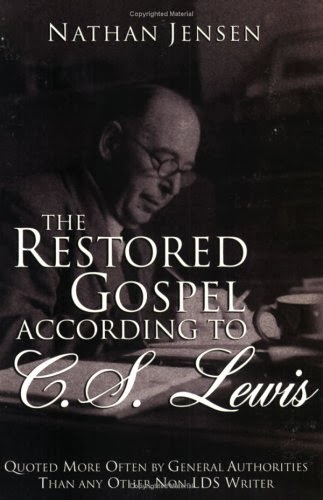
The Restored Gospel According to C. S. Lewis

I received a copy of The Restored Gospel According to C. S. Lewis by Nathan Jensen years ago, but I had only read excerpts up to this point. Finally I decided to read the entire book, and I'm glad I did. I have always greatly respected C. S. Lewis' writings, and this book just make me appreciate him even more. In this book, Jensen compares various statements from C. S. Lewis with general authorities of The Church of Jesus Christ of Latter-day Saints. It is remarkable how many of these coincide perfectly.

My only complaint with this book is that some of the Lewis quotes get repetitive. Each chapter is divided into different subjects, and often the author uses the same quote repeatedly because it fits each new subject matter. Doing so reduces the novelty of the quote and softens its impact. That being said, there were several quotes from this book that I really enjoyed. These are a few:

C. S. Lewis talks about God taking great pride in His creations, just as an artist takes great pride in his paintings. Unlike an artist's painting, however, we are sentient creatures and whenever the Grand Artist makes changes or enhances His creations (us) we complain and moan because we think we are fine as we are. We cannot yet see the grand masterpiece our Master has in mind for us to become.

I also loved C. S. Lewis' description of angels and devils. He said that they are as similar as good and bad people, meaning that they are the same kind of beings. Devils are not creatures with pointed tails and horns, nor are angels creatures with bird wings. In fact, Lewis' entire conception of Hell and the devil is extraordinary and very accurate compared to what I believe.

Another quote I want to touch on regarding this subject is actually by Brigham Young. He taught that music is a language from heaven and is a great gift to mankind. He followed that up by saying there is no music in Hell. I had never thought about this before, but I found that very interesting.

Last of all, I loved what Lewis had to say about religion and sacrifice. He was very against "soft religions" that did not take the Bible at face value and tried to diminish was Christianity is meant to be. He especially deplores those who twist the Bible to mean things it did not say. He emphatically declared that either Jesus is the Son of God and everything He said or did is true, or else He was an immoral liar or a madman. You cannot believe in Him without believing EVERYTHING.

These quotes and so many more reinforced my admiration for the great man that was C. S. Lewis.

Thursday, December 12, 2013

Jerusalem: The Eternal City

If you are looking for a great book to understand Jerusalem's history, then I highly recommend Jerusalem: The Eternal City by David B. Galbraith, D. Kelly Ogden, and Andrew C. Skinner. This book begins its history with the city of Salem, under the rule of Melchizedek and goes until the time of the book's publication. This was an eye-opener for me. This is one complicated city!

Although this is not light reading, I am impressed with the quality of this book. The authors do a great job of helping the reader understanding the context of its history, even so far as to explain the part of Jerusalem's history that Indiana Jones and the Raiders of the Lost Ark is based on.

The part of the book that I perhaps enjoyed the most was where it discussed the history of the city after the crucifixion of the Savior. In A.D. 70, the city and temple were destroyed. This had been prophesied by Jesus years earlier. What is neat is that the authors show how every point of this prophecy was fulfilled, including the false prophets and false messiahs that rose up during this time period. These false leaders were largely responsible for a lot of the devastation.

In connection with this, I was most impressed with the profound sorrow of the Jews when the temple was destroyed. To them, it was symbolic of no longer having God in their midst (little did they realize they crucified their God over thirty years earlier). Records report of Jews weeping for days when they saw the temple was destroyed, and even today they have symbolic reminders that their lives are not complete without a temple. For example, for most of my life I have known that at Jewish weddings the groom breaks a glass under his foot, but not until I read this book did I understand that it was a reminder of the loss of the temple. Some women leave off a piece of jewelry, others leave a portion of their buildings unpainted. All of these are to remind them that until they once again have a temple, they can never be complete. What a profound thought, and one that I think is easily applied to Latter-day Saints.

Furthermore, this book goes into great depth about Islam, giving it an equal treatment with the Jews. The more I read about the two religions and the holy regard they both have towards Jerusalem, the more I realized just how complicated this city is. Jerusalem is a city with a bloody history, with blood being shed by Jews, Muslims, and Christians. Everybody is at least somewhat in the wrong. The authors conclude that only the coming of Messiah can finally set things right.

For anybody interested in learning more about Jerusalem, its history and destiny, I highly recommend this book. Don't expect a light reading, but you bring your reading plow, you're going to dig up a lot of really great information.

Saturday, November 30, 2013

BYU Speeches: Adversity

My wife got a copy of this collection of BYU Speeches revolving around the theme of adversity. It is also subtitled "Finals Survival Kit Speeches." It contains a collection from Jeffrey R. Holland, James E. Faust, Spencer W. Kimball, and Vaughn J. Featherstone. Each talk was excellent and had suggestions and insights that I found very helpful when it comes to dealing with adversity in my own life.

Jeffrey R. Holland actually has two talks used in this book, both titles of which have since been used in books he has written: However Long and Hard the Road and For Times of Trouble. I really love Elder Holland, and it was great to read these talks, and especially to hear him give encouragement. In fact, this whole book is one worth reading again and again.

Overall, I learned a very important thing from this book. Life is full of trials. We need to expect them and work with them, not wait to live until the trials have passed. It is enduring through the trials and living faithfully through the trials that produce the outcome the trials were meant to bring about in the first place. A common characteristic among all these speakers was humor. Good, appropriate humor helps us endure trials faithfully and come out on top.

The other lesson I learned is to encourage others who may be going through trials right now as well. Giving comfort and encouragement to others will not only bless their lives, but it will bless ours also. Joining together, we can make it through anything. But most important of all, we must unite ourselves with our Savior Jesus Christ. It is He who overcame all things. It is He who is our defender and shield. It is He who is our Comforter and Friend. It is He who can mold us into who we are destined to become.

Tuesday, November 19, 2013

The Guardians of the Finisher's Fury

Frank L. Cole, who is the author of The Guardians of the Finisher's Fury also happens to be my manager. I am fortunate enough to also be able to read his latest works in advance. I got to read an advance copy of this book at the end of 2012. In fact, I stayed up reading this through the night on New Year's. This last week I had the opportunity to read the latest book that Frank completed. However, since it is still in its earliest editing stages, I thought it would be unfair to review that book now. Instead, I will review The Guardians of the Finisher's Fury since it has finally been officially released.

The fact that I stayed up late into the night to finish this book should say something about how much I enjoyed this book. Frank's books have a tendency to grab the reader and pull them into the story. Not only is the plot gripping and intense, but the author's classic humor shines through the pages as well.

The Guardians trilogy focuses on two main characters named Amber and Trendon. amber has a special bond with her former archeology teacher named Dorothy and together, the three of them have been searching for ancient artifacts with special powers. They are also racing against a group of people who call themselves Architects. This group has a fascinating history as well that I will not spoil here.

In the first book, Amber and Trendon together discover the Tebah stick. Through this stick, Amber has the gift to communicate with animals that have not been seen since the days of Noah's Ark. Not only can she communicate with these creatures, but she can also order them with her very thoughts. The second artifact was Elijah's Fire, an axe with the ability to call fire down from heaven.

Now, in this third and final book, they are looking for the most powerful and dangerous artifact of all: The Finisher's Fury. Not only is this artifact extremely dangerous, but if it should ever be combined with the other two, it could mean the destruction of the world if it got into the wrong hands. The question is, can anybody really handle having power like that? This dangerous artifact has the potential to turn friends into foes. Can Amber and Trendon survive this challenge? Discovering and protecting this artifact is destined to be their most difficult challenge ever, and they will never be the same!

I highly recommend this book, and not just because the author is my boss. If you like Indiana Jones-style stories, you will love this. It is packed with action, humor, intrigue, and suspense. If you like that kind of book, make sure you put this trilogy on your list!

Friday, November 8, 2013

The Continuous Atonement

Back in 2010 I had read all but one chapter of The Continuous Atonement by Brad Wilcox. When I saw it was the next book on my shelf, I decided to re-read the entire book and not just finish the last chapter. I'm so glad I did! I had forgotten what an incredible book this is!

The basic idea of Wilcox's book is that the atonement of Jesus Christ does not have a limit to it, following the scripture that says, "And as often as my people repent I will forgive them." But there is more to it than that. Sometimes we might think that the Savior's grace won't take effect until we have done everything in our power. This is a false concept. The Savior's grace actually helps us do everything in our power, and then enables us to do even more.

The beauty of the atonement is that it enables us to become better people. It doesn't just restore us to the way we were before, but it enhances us. This book actually shed some light on a concern I've had before. Often, especially when I am very tired, I have the crazy thought that I don't want to live forever. It sounds exhausting to me! Sure, a reunion in Heaven sounds grand, but after that reunion is over, I've struggled with the idea of living forever. I've actually wished there could be an end.

Wilcox discusses how immortality is only a partial gift. The fulness of the gift is an eternal life of progression. In the author's words, "There will always be something more to look forward to and achieve." The quality of life that Christ's atonement makes possible and the many wonderful opportunities before us make eternity a wonderful gift and blessing!

The author also makes a point that hit close to home. He was talking about a time in his life where he felt he was on a roller coaster with ups and downs all day long. I can certainly relate to that! One night, after discussing the way he felt to his wife and expressing a wish that life would be smooth, his wife (who was a nurse) said, "when a heart monitor is showing ups and downs it's a good thing. When it's flat, that's bad. Going up and down means you're still alive." I'm glad I'm still alive!

For anyone seeking to understand the atonement better, and especially for those seeking to understand how it applies to them, I highly recommend this book!

Tuesday, November 5, 2013

History of the Church Vol. 7

With the reading of History of the Church Vol. 7, I have concluded the documentary History of the Church series. The way this book was put together made parts of it repetitive, although the information was very interesting. My favorite part was where I got to read excerpts from Brigham Young's journal.

The book begins with Governor Thomas Ford's history of the Mormons in Illinois. Reading his own perspective earned the governor absolutely no love from me. At one point he mentioned that he would probably be remembered as a Herod or a Pilate among the Mormons. He was right. He was a dishonest and despicable man.

This volume of the Church's history contains information about the leadership of the Church being assumed by the 12 Apostles. Before reading it, I never knew just how far off the deep end Sidney Rigdon had gone. The claims he was making and the movements he was pursuing were in direct contrast to established revelations. It would make sense that he would win over a few followers because of his long involvement with Joseph Smith, but after reading his ideas and claims it was even clear for me to see he was not an inspired leader chosen of the Lord to lead the Church.

On the same note, it was sad to read about many in the Church who broke themselves off because they wanted power and authority. Even some members of the Twelve (the prophet's brother William included) turned against their brethren to try to start their own movements. What a blessing that so many relied on testimony and not on flattery. An interesting thing I read, however, on page 367 is a discourse Brigham Young gave on how to correct those who need correcting. He emphasized the need to have charity and the Spirit when doing any correcting because if it is done in an inappropriate way, it could discourage, embarrass, and destroy the person instead of leading them to true repentance. I found that teaching very profound.

I got a kick out of a list of nicknames for the Twelve Apostles that were published in a newspaper:
Brigham Young, The Lion of the Lord
Heber C. Kimball, The Herald of Grace
Parley P. Pratt, The Archer of Paradise
Orson Hyde, The Olive Branch of Israel
Willard Richards, The Keeper of the Rolls
John Taylor, The Champion of Right
and so forth.

This volume also focused heavily on the building and completion of the Nauvoo Temple. I was surprised to read that they held dances inside the temple at one point, until Brigham Young put an end to it because he thought it detracted from the holy nature of the place and the work therein. It was neat to read how important the temple was to the early saints and how much they desired the blessings of it. Orson Pratt gives a wonderful discourse in this volume in which he laments those who sacrifice eternal kingdoms and glory to a moment's gratification.

Unfortunately, this volume ends rather abruptly. I have decided that I need to invest in The Comprehensive History of the Church in order to learn more. But I highly recommend this entire series to anyone wanting to learn more about the church's history and early teachings. I have felt the Spirit many times during the reading and I have loved coming to know Joseph Smith better. I have also felt pangs of sorrow as some heroes I read about turned away from the Church. In contrast, I have been elated when I have read about some of those who turned away and then repented. What a remarkable book series to read!